The Droid Inevitability
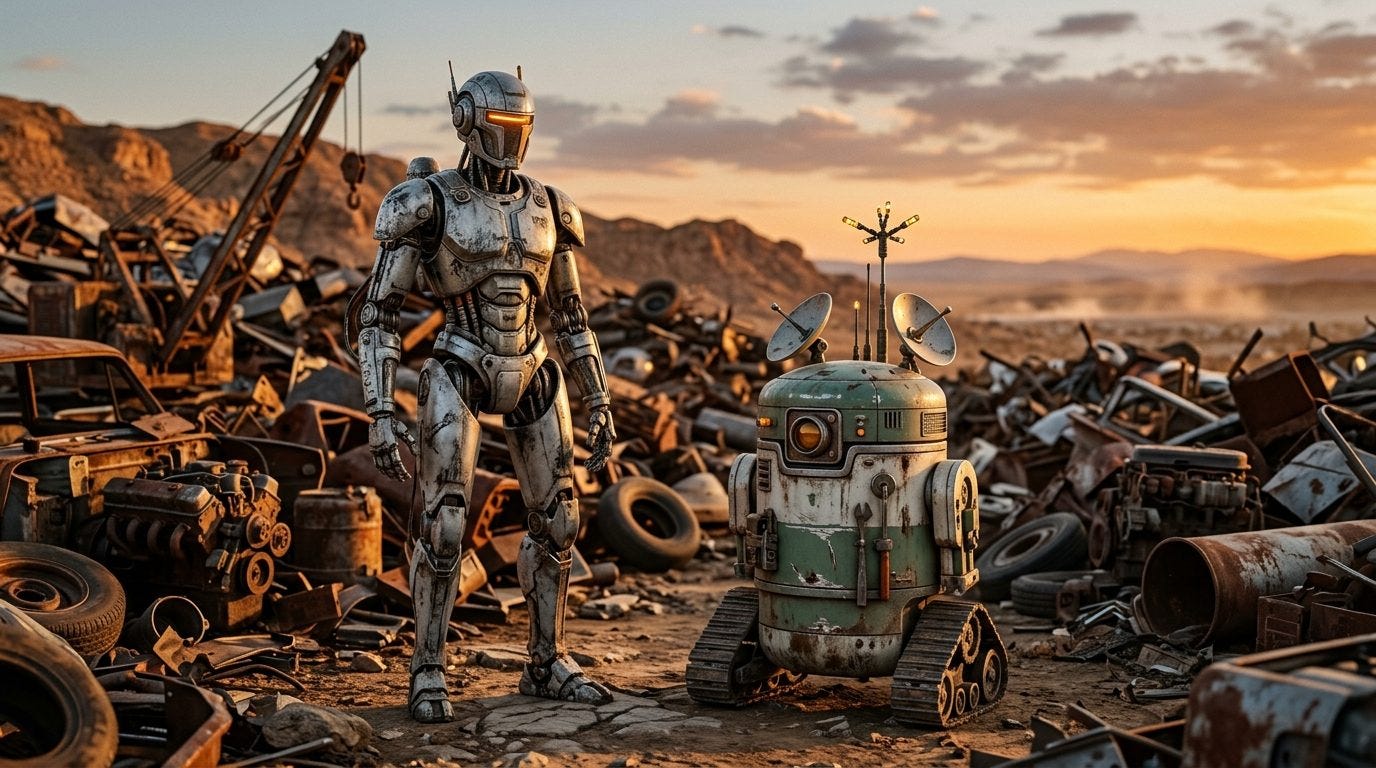
I was getting ready to take my family to Disneyland and my kids had never seen Star Wars. I didn't want them wandering through Galaxy's Edge wondering who the guy in the black helmet was, so one night I sat with them on the couch and showed them a few scenes from Episode IV. Honestly just a few minutes scattered throughout the movie so they'd know a few of the characters.
That was supposed to be it.
But over the next few days they kept asking about Star Wars. Maybe they were just feeding off my energy, I don't know. But by the time we got to Disneyland, they were obsessed. Every time we passed the Star Wars area gift shop, they had to stop and just stare at the robots in the window. They didn't even go on the ride.
A nearly fifty-year-old movie. And it grabbed them instantly. Why?
I don't think it's nostalgia, and I don't think it's clever marketing. I think kids gravitate toward Star Wars because somewhere in their intuition they recognize it as true. Not true as in historically accurate. True as in: this is the future that's actually going to happen.
There's a concept called the Noosphere, the idea that human thought creates a collective sphere of intelligence that eventually manifests physically. When a society spends half a century imagining a world of independent, helpful droids, it directs capital, research, and supply chains toward that exact outcome. We don't just predict the future. Through something like a quantum-level shared intent, we construct it.
That's a big claim. So let me walk through the mechanical and economic evidence for why the future really does point toward autonomous droids and scrap piles, not a centralized invisible computer.
Intelligence will be as free as an mp3
Right now, AI is a utility you rent. The smart stuff lives inside data centers owned by a handful of massive companies, and you pay a monthly fee to borrow a slice of it. They're spending tens of billions, maybe hundreds of billions, to build these refineries.
That's a phase. It's not the end state.
Once a model is trained, it becomes a file. A frozen set of numbers that can be copied, shipped, and run anywhere. Some of the biggest companies in the world are already giving these files away for free. Partly to undercut competitors. Partly because they've realized the intelligence itself isn't where the money is going to be.
This isn't theoretical. Google already has a free app that lets you download AI models and run them on your phone with no internet connection. The free downloadable models already score within a few points of the best paid ones on most tasks, and the gap shrinks every few months.
In a few years, a genius-level AI is going to be something you download once and keep forever. The same way you download a song. The subscription model we have today will look as dated as paying AOL by the hour.
No internet needed
Once intelligence is a file, you can put it on a chip. Once it's on a chip, you can put the chip inside a robot. Once the robot has the chip, it doesn't need to phone home to a data center to think.
Add a solar panel and a battery, and you have a robot that wakes up with the sun, runs its own brain locally, and costs nothing to operate. No subscription. No Wi-Fi. No corporate server that can go bankrupt and brick the device you already paid for.
That's a sovereign droid. And it's not thirty years away.
The scrap pile economy
This is the part of Star Wars that used to bug me as a kid. Why is everything so dirty? Why is Luke's speeder dented? Why do Jawas sell used droids out of the back of a Sandcrawler?
Now I get it. When the brain of the machine is a free download, the body becomes the only expensive part. Hardware rusts. Software doesn't. You end up with an economy where a ten-year-old robot with a dented chassis gets pulled out of a junk pile, fitted with a new battery, flashed with the latest free AI model, and suddenly thinks as sharply as anything rolling off the factory floor.
That's the Star Wars economy. New minds in old bodies.
Back to the couch
My kids didn't have a spiritual awakening watching Episode IV. They just thought R2 was funny.
But I think their instinct was right. A movie from 1977 still hooks a kid in 2026 because we collectively drafted this future a long time ago. We're still drafting it every time another kid falls in love with a beat-up droid. Maybe they can feel, in whatever way kids feel things they can't articulate, that out of all the possible futures, this is the one that's actually coming.
The engineering is catching up to the imagination. The scrap piles are coming. And the intelligence to run them is already being built in the refineries, getting ready to be set free.
This essay first appeared on Medium.